Strategy guide · Kingfisher
Solve the habitat, not just the square
Kingfisher asks you to place exactly one bird in every row, column, and outlined habitat. Birds also cannot touch, including at diagonal corners. The fastest solutions come from treating those four rules as one connected system.
By Green Bean Studio · Published · Reviewed
Start here
Translate every rule into exclusions
A bird placement does more than finish one cell. It rules out every other cell in the same row, the same column, and the same habitat. It also rules out all adjacent cells, including diagonals. Marking those exclusions immediately is the core habit of accurate play.
- Scan rowsIf a row has only one unmarked cell left, that cell must contain its bird.
- Scan columnsUse the same check vertically. A placement may reduce a distant column to one candidate.
- Scan habitatsIgnore the rectangular grid for a moment and trace each outlined area. If one candidate remains inside it, place the bird.
- Mark neighborsAfter placing a bird, exclude every touching cell before looking for the next move.
Reliable process
Use a short deduction loop
Do not search the entire board for a brilliant move. Repeat a fixed circuit: completed rows, completed columns, completed habitats, then no-touch exclusions. Each pass changes the candidates available to the next one.
Place forced birds
Check any row, column, or habitat with one candidate. These are definite moves, so make them before comparing more complex shapes.
Propagate the result
Cross out the rest of the bird’s row, column, and habitat, then all eight neighboring positions that exist on the board.
Rescan all three units
A single exclusion can create a new last candidate in a different habitat, which then resolves another row or column.
Visual examples
Turn every placement into a fresh candidate scan
Kingfisher boards contain the same number of habitats as rows and columns, with exactly one bird in each. The screenshots below show how a habitat deduction and the no-touch rule create useful exclusions across the board.
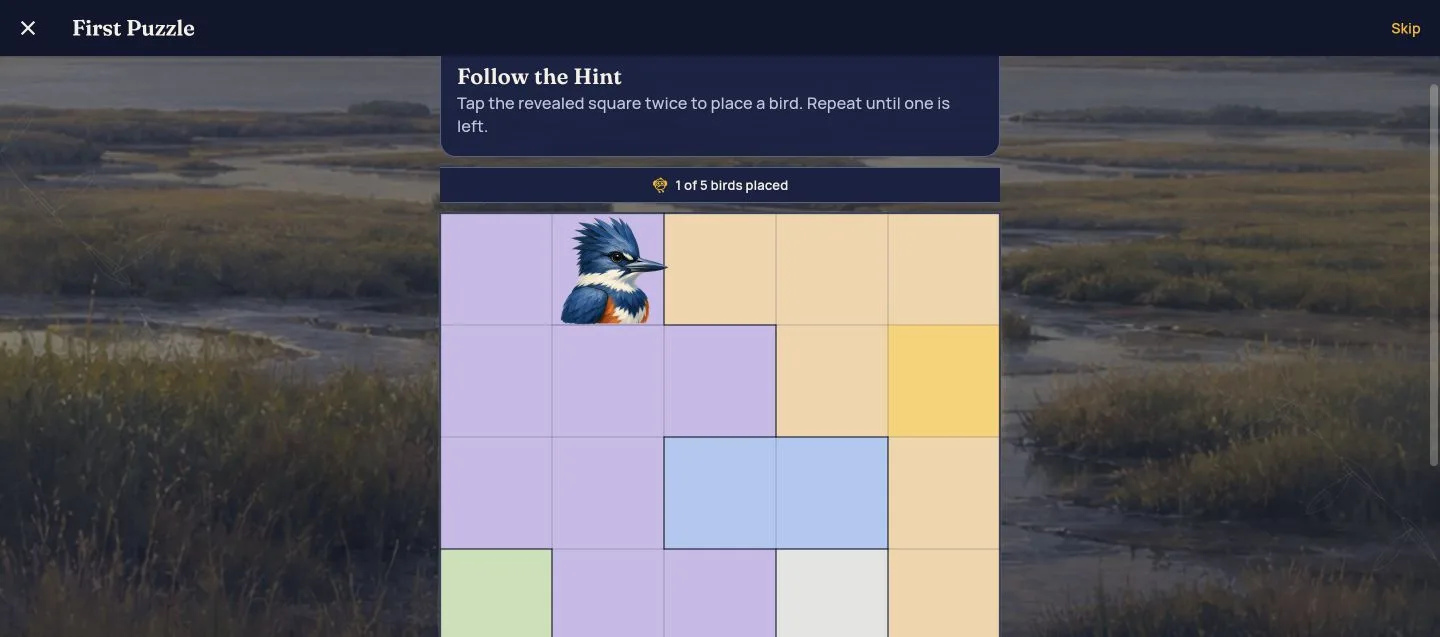
Scan the whole habitat
Follow the colored boundary through every bend. When all but one square in that habitat carry an exclusion, the last square holds its bird—even if its row still has several open cells.
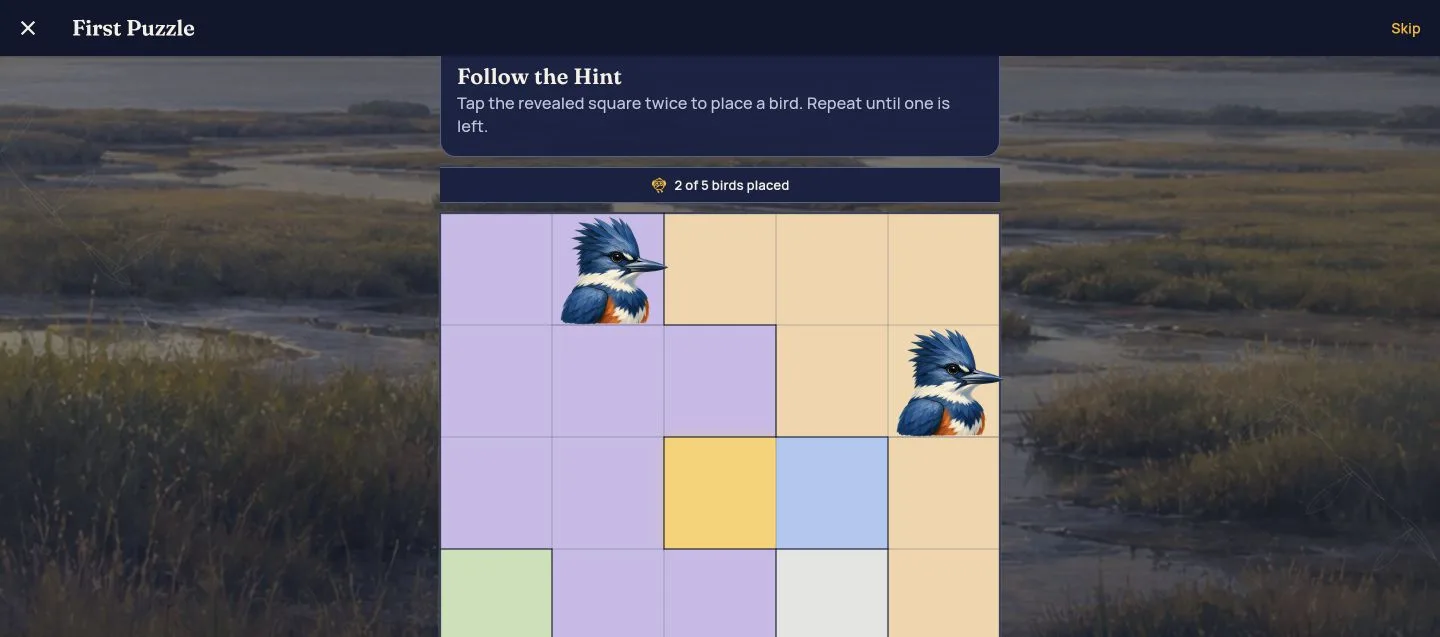
Protect the full perimeter
A bird excludes all touching squares, including diagonal corners, as well as every other square in its row, column, and habitat. Mark that complete footprint before searching for another bird.
Worked reasoning
A placement can force a chain
Consider a six-by-six board. Habitat Amber has three candidates: row 2 column 2, row 2 column 3, and row 4 column 3. Another confirmed bird sits at row 3 column 2. The first Amber candidate touches it vertically, and the second touches it diagonally. Both are illegal, so Amber’s bird must be at row 4 column 3.
Now apply every consequence of that placement. All other cells in row 4 and column 3 are excluded, as are the remaining cells in Habitat Amber. The cells at rows 3 and 5 and columns 2 through 4 are also excluded because they touch the new bird. Suppose Habitat Blue previously had candidates at row 4 column 5 and row 6 column 5. Row 4 is now occupied, so Blue must use row 6 column 5. That new bird may finish column 5 or constrain a neighboring habitat.
The useful lesson is not the coordinates. It is the order: use adjacency to resolve a habitat, use the placement to close a row, then use that row to resolve another habitat. Kingfisher boards are built from these overlapping consequences.
Candidate patterns
Notice where a habitat is allowed to land
A habitat does not always need to be reduced to one square before it helps. If all candidates for a habitat lie in the same row, that row’s bird must belong to that habitat. Every cell in that row outside the habitat can be excluded. The same reasoning works when all of a habitat’s candidates lie in one column.
Now combine that idea with the no-touch rule. If the only two candidates in a habitat are adjacent positions in one row, you cannot yet choose between them, but you know nearby cells that touch both candidates cannot contain birds. Shared-neighbor exclusions are useful because they are true whichever candidate is eventually selected.
Keep the claim narrow. Exclude a cell only if every remaining position for the relevant bird rules it out. This avoids turning a useful pattern into a guess.
When stuck
Audit the board in a different order
First, verify that every placed bird has its full set of row, column, habitat, and neighbor exclusions. Missed diagonal exclusions are especially easy to overlook. Second, inspect the smallest habitats; their irregular edges often create tighter candidate sets than a row does. Third, inspect rows and columns that already contain many excluded cells. Finally, look for a habitat whose remaining candidates all share a row or column.
Avoid speculative placements. Kingfisher states that each board has one clear solution, so a correct next step can be justified from the visible constraints. If two cells still look interchangeable, leave them unresolved and work elsewhere. Another placement will usually separate them.
Accuracy
Separate facts from possibilities
Use bird marks only for forced placements and exclusion marks for cells that are impossible. Do not place a bird merely because a square looks likely. Before committing, state the reason in one sentence: “This is the only cell left in the habitat,” “the row has one candidate,” or “the other candidates touch an existing bird.” If you cannot state the reason, keep scanning.
After every placement, pause before searching for another. Most avoidable mistakes happen when a correct bird is placed but one of its consequences is not recorded. A deliberate update takes less time than repairing a contradiction later.
Puzzle lineage
A nature-themed branch of region-placement puzzles
Kingfisher belongs to a broader object-placement tradition in which rows, columns, outlined regions, and non-touching pieces constrain one another. Grandmaster Puzzles’ Star Battle rules and brief history traces that named style to a puzzle by Hans Eendebak for the 2003 World Puzzle Championship, while noting an earlier related puzzle called Cattle. Star Battle can require one or more stars in each unit, so the family is broader than Kingfisher’s exactly-one-bird rule.
A recent one-piece presentation is LinkedIn’s official Queens rules: one crown in every row, column, and colored region, with crowns unable to touch even diagonally. Kingfisher uses that recognizable one-per-unit logic while giving it a distinct bird-and-habitat setting, outlined habitat shapes, and its own progression and bird-discovery presentation. The shared mechanics describe a lineage, not an invention claim for any one modern theme.
Next board
Practice the loop in Kingfisher
Read the full game overview, download links, support information, and privacy details on the Kingfisher pages.