Strategy guide · Sundown
Make every symbol satisfy every test
Every Sundown cell contains a sun or a moon. Each row and column must be balanced, three identical symbols cannot appear consecutively, completed lines cannot repeat, and marks between cells tell you whether a pair matches or differs. Strong play checks every applicable constraint before filling a cell.
By Green Bean Studio · Published · Reviewed
The rules
Know what each constraint can force
On an even-sized board, balance means half the cells in every row are suns and half are moons. The no-three and no-duplicate rules apply to both rows and columns. Edge marks connect two adjacent cells and require either equal or different symbols. Sundown boards have exactly one logical solution.
- BalanceA 6×6 line contains three suns and three moons. An 8×8 line contains four of each; the same half-and-half rule extends to the larger sizes.
- No triplesAny run of three cells must contain both symbols. Sun–sun forces moon at either open end, and sun–blank–sun forces moon in the middle.
- Unique linesNo two completed rows may be identical, and no two completed columns may be identical. A nearly finished line can therefore be forced to differ from one already completed.
- Edge marksA match mark makes its two cells equal. A differ mark makes them opposites. A known cell therefore determines its marked neighbor.
- One solutionYou do not need to guess. If a move lacks a rule-based explanation, leave it and inspect another line or clue.
Visual examples
Read the board in small, decisive groups
These in-game positions isolate two common deductions. Look at the highlighted cells first, name the rule that applies, and only then carry the new symbol into its row and column.
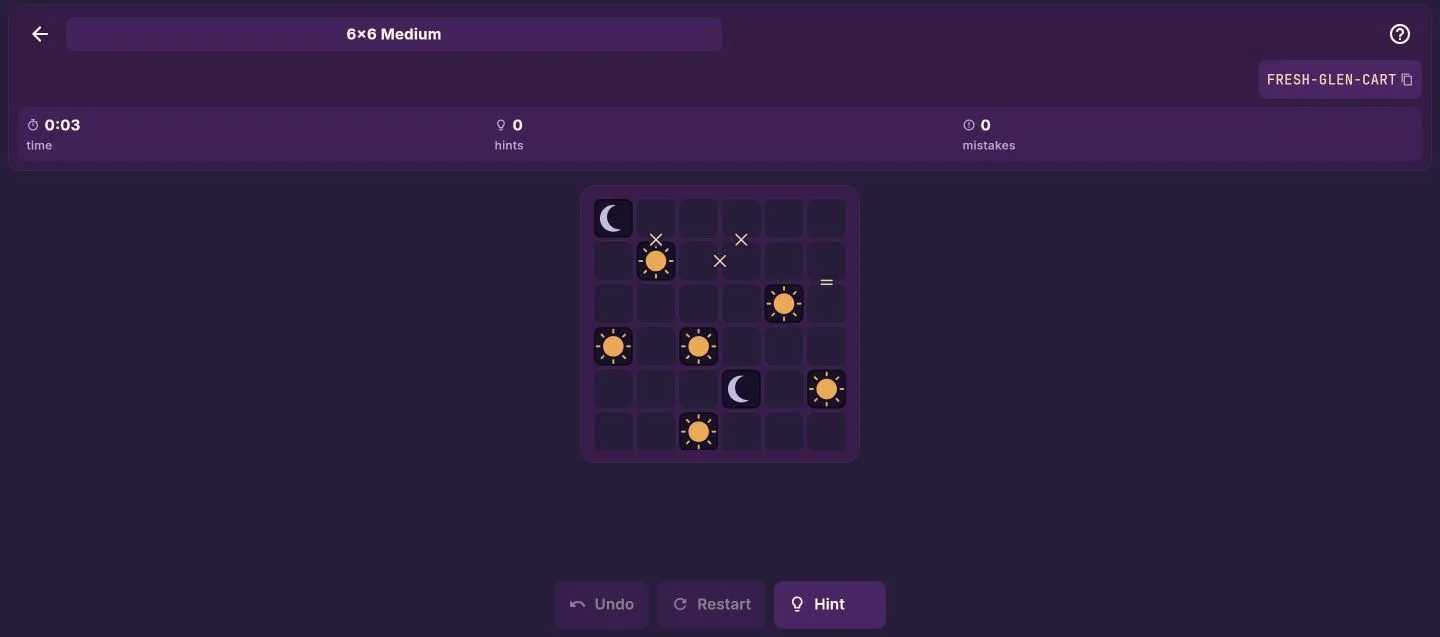
Balance the pair
Once a line has reached its quota of suns or moons, every unfilled cell in that line takes the other symbol. Record both forced cells, then rescan their columns.
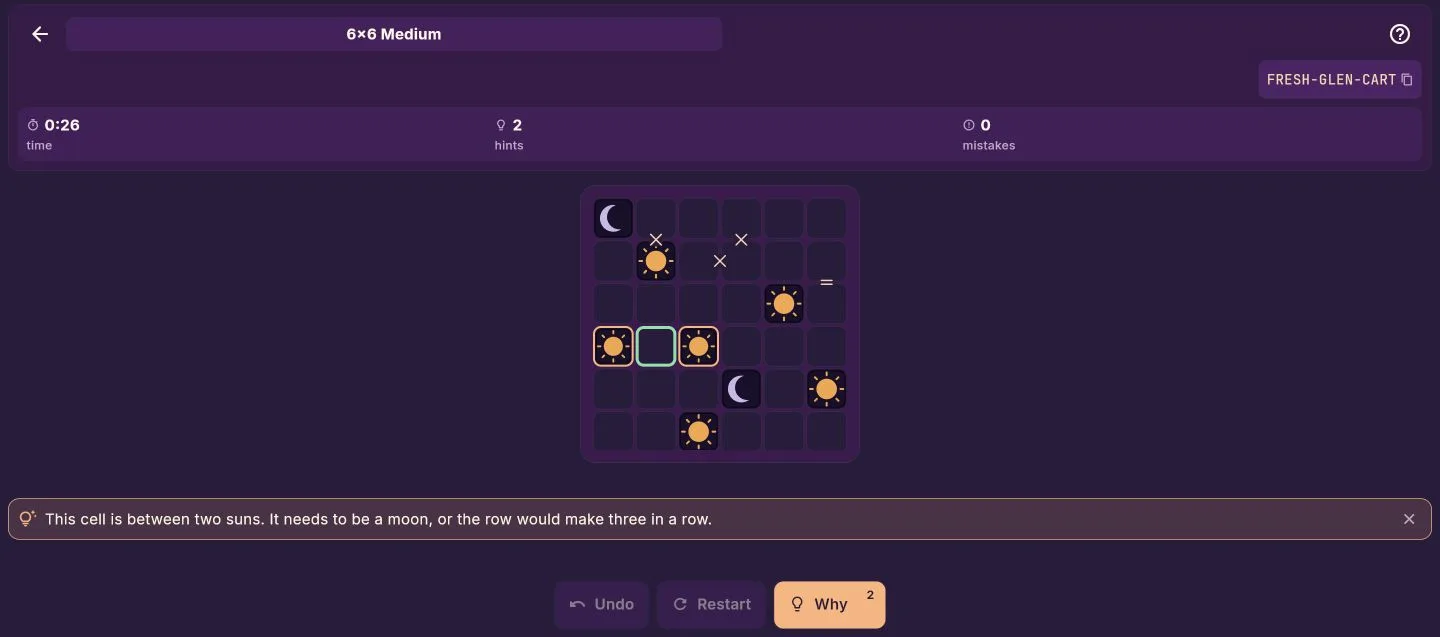
Break the run
Two matching adjacent symbols force the open cell at either end to be the opposite. The same logic fills the center of a matching symbol–blank–symbol pattern.
Fast patterns
Block triples before counting the whole line
The no-three rule produces the quickest local deductions. If two adjacent cells are both suns, the cells immediately before and after that pair, when present, must be moons. The same is true with the symbols reversed. If two matching symbols have one blank between them, that blank must be the opposite symbol.
For example, read a row segment as sun, blank, sun. Placing a sun in the blank would create three suns, so the blank is a moon. Now read moon, moon, blank. The last cell is a sun. These patterns work vertically as well as horizontally, so scan columns after every group you resolve.
Do not apply a triple rule across a gap larger than one cell. Sun, blank, blank, sun does not by itself determine either blank. The deduction depends on a consecutive group of three.
Line totals
Finish a line as soon as one symbol reaches its quota
On a 6×6 board, suppose a row already contains three suns and has two empty cells remaining. Both empty cells must be moons, because the row cannot contain a fourth sun. Conversely, a row with three moons must fill every remaining cell with suns. On an 8×8 board, the trigger is four of one symbol; on a 10×10 it is five; on a 12×12 it is six.
Counting also combines with the no-three rule. Imagine a six-cell row that reads sun, sun, blank, moon, blank, blank. The third cell must be a moon to block a triple. The row now has two suns and two moons. If another rule supplies a sun in the fifth cell, balance forces the sixth cell to be a moon. That last moon may then resolve cells in its column.
Count completed and incomplete lines regularly. A symbol forced by a column can cause a row to reach its quota, and the resulting row completions can then finish several columns.
Edge clues
Treat marked pairs as small equations
For a match clue, knowing either cell gives you the other: sun pairs with sun, and moon with moon. For a differ clue, sun pairs with moon. This simple relationship becomes more useful in a chain.
Suppose cells A and B must match, while B and C must differ. If A is a sun, B is a sun and C is a moon. If A is still unknown, you can still conclude that A and C differ. That relationship may matter when A and C also fall into a near-complete row or column.
Now add the no-three rule. If a marked match pair occupies the last two positions in a three-cell run whose first cell is a sun, the pair cannot both be suns. Both must therefore be moons. Likewise, if a differ pair follows two known symbols, test each permitted orientation against triple and balance constraints. Rejecting one orientation makes the other definite.
Late-board deduction
Compare a nearly complete line with finished lines
Duplicate prevention matters most after several rows or columns are complete. Suppose a row has one blank and otherwise matches a completed row cell for cell. The blank cannot take the value that would make the two rows identical, so it must take the opposite value. Confirm that result against balance and no-three before writing it.
This rule only compares complete lines. Two partial rows that currently look alike may later diverge, so resemblance alone does not justify a move. Use the tactic when the candidate value would complete an exact copy.
Worked reasoning
Resolve a row, then carry the result into a column
Take a 6×6 row with this state: sun, sun, blank, moon, blank, blank. First, the third cell is moon because three suns cannot be consecutive. Assume a differ mark connects the fourth and fifth cells. The fourth is moon, so the fifth is sun. The row now has three suns—positions one, two, and five—so its last blank must be moon.
Move to the column containing that last moon. If the two cells directly above it are already moons, that would be an illegal triple; therefore that earlier board state cannot occur on a valid puzzle. More commonly, the new moon completes a separated pattern such as moon, blank, moon, forcing the middle cell to sun. Or it may bring the column to half moons, forcing all remaining blanks in that column to suns.
This is the normal solving rhythm: local pattern, edge relationship, line balance, then a perpendicular line. Revisit the board after each small chain instead of trying to finish one row in isolation.
When stuck
Use a fixed scan order
Check every adjacent pair for open ends. Check every symbol–blank–same-symbol pattern. Count suns and moons in each row, then in each column. Follow every edge mark connected to a known symbol. Finally, inspect marked chains that cross lines which are nearly balanced.
If no move appears, verify earlier entries against all rules. A cell can satisfy its row while violating its column, and a pair can satisfy an edge mark while creating a triple. The correct value must pass every applicable test at once.
Larger boards do not require different rules; they require better bookkeeping. Finish the most constrained lines first, propagate every result in both directions, and avoid guessing. Sundown’s hints explain logic when you need help, but the same systematic scan will resolve many stalls.
Puzzle lineage
Binary logic, presented as a day-and-night board
Sundown shares its core balance, no-three, and unique-line structure with the puzzle family commonly called Takuzu, Binairo, or Binary Puzzle. The Takuzu overview and list of alternate names shows how the same two-state framework has appeared with digits, letters, and other symbols rather than one fixed visual language.
Paired pictures are now a familiar way to make that logic immediately readable: LinkedIn’s official games guide describes Tango with two distinct emoji, equal row and column counts, and no runs longer than two. Sundown uses its own sun-and-moon presentation and adds match and differ marks between neighboring cells. Those edge clues are part of Sundown’s rules, not a claim that Green Bean Studio originated the wider binary-puzzle family.
Keep solving
Apply the patterns in Sundown
The Sundown page includes download links, supported grid sizes and difficulty levels, and the full app overview.