Wax Key guide · 8 min read
Wax Key strategy: make each clue shrink the grid
Wax Key is a crime-themed logic-grid game with thirty authored cases. Each case asks you to match every suspect to one item in each category, such as a tool, room, motive, hiding place, alias, aisle, or cargo tag. The clues support one solver-validated solution. The goal is not to guess the culprit from the story’s mood; it is to record enough exact matches and exclusions that only the complete mapping remains.
Translate prose into grid facts
Read a clue once for the story, then a second time for its mechanical claim. “Mara carried the lantern” is a direct match between Mara and lantern. “The person in the archive was not Mara” is a direct exclusion. A clue that links two attributes—“The lantern was found in the archive”—can be used even before either attribute is attached to a suspect. Keep that relationship in mind until one side gains a name.
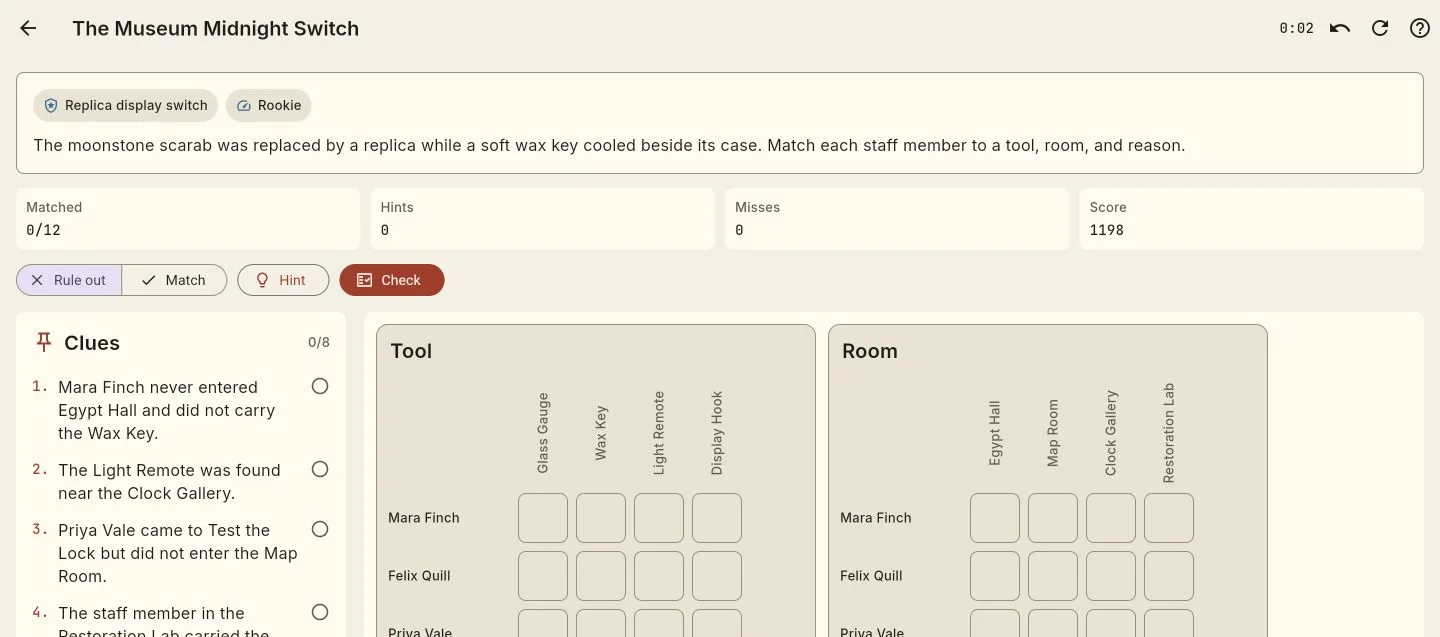
Use the clue checklist to track which statements you have processed, but remember that an old clue can become useful again after a new match. “Checked” means recorded or understood; it does not mean the clue has no remaining consequences.
Use Rule Out broadly and Match carefully
Rule Out places an exclusion in a single cell. Use it whenever a clue proves that a pairing cannot be true. Match is stronger: it confirms the selected pairing and automatically rules out every other item in that suspect’s row and every other suspect in that item’s column. That behavior enforces the one-to-one structure of each category.
Because Match propagates across a row and column, place one only when the pairing is certain. If a clue merely narrows Mara to the lantern or rope, rule out the other tools and leave those two cells undecided. A premature match can make the board look cleaner while pushing several wrong exclusions into place.
Finish almost-complete rows and columns
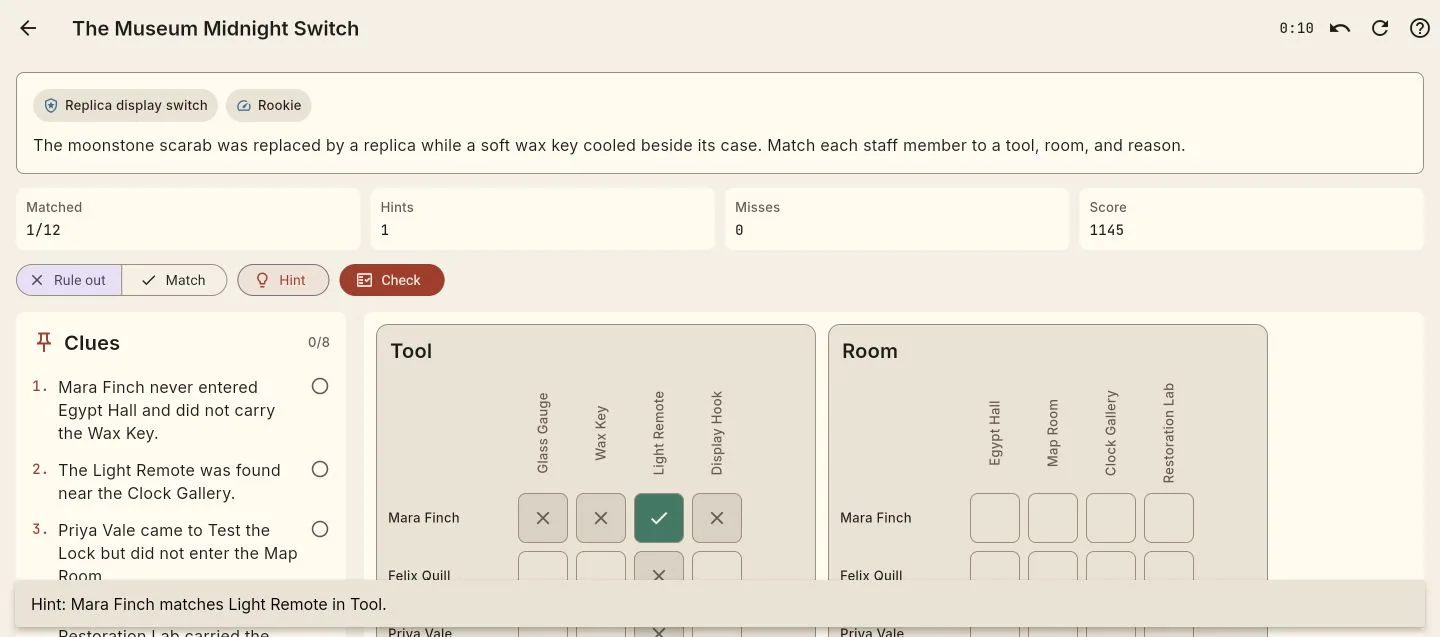
After every direct clue, scan the affected row and column. If a suspect has only one possible item left in a category, that cell must be the match. The same logic works from the item side: if only one suspect can still have the archive key, that suspect must have it. Confirming the match clears its row and column, which may create another single possibility elsewhere.
This chain reaction is the main solving rhythm: enter a clue, scan for a forced match, propagate it, and scan again. Do not read all the clues first and postpone the grid work. The board is a memory aid and a deduction engine.
Join clues through a shared attribute
Many useful deductions require two statements. If the lantern belongs to the person in the archive, and Mara was not in the archive, Mara cannot have the lantern. If the rope belongs to the red badge, and Jules has the red badge, Jules has the rope. Translate the chain into the corresponding category grids so the conclusion remains visible.
When stuck, choose one unmatched attribute and trace every clue that mentions it. Write down what it must match, what it cannot match, and which suspects remain possible. Then repeat from the opposite side of the relationship. A clue that seemed vague often becomes exact after one of its attributes is fixed.
Use Check, Hint, and Undo deliberately
Check completes the case only when the marked mapping is solved. If the current grid contains wrong matches, checking records a mistake. Undo restores the previous grid state for the most recent move, which is especially useful after a Match caused automatic row-and-column exclusions. Restart clears the case if you want a clean board.
A hint fills the next unresolved correct match and counts as a hint in the final record. Before requesting one, identify the category where you are stalled and make one full pass through its rows, columns, and related clues. After the hint appears, explain why the new match is consistent with the clues; that turns the answer into a reusable technique.
A dependable case routine
Start with direct matches and direct exclusions. Propagate every confirmed match across its row and column. Find any row or column with one possibility left. Revisit relational clues using the new matches. Repeat until all categories are mapped, then use Check. The game tracks time, hints, mistakes, score, and solved-case stats, but a clean logical explanation is the best measure of a strong solve.
Puzzle lineage: logic grids and the Zebra Puzzle
Wax Key stands in the logic-grid tradition often associated with the Zebra Puzzle: prose clues constrain a one-to-one mapping among people and attributes until a complete arrangement is forced. The documented version of the Zebra Puzzle published by Life International in 1962 asks solvers to determine a full set of houses, colors, pets, drinks, and other attributes. The often-repeated Einstein authorship claim is unsupported, so this guide does not repeat it as history.
Modern research treats these puzzles as constraint-satisfaction problems; the ZebraLogic research paper describes logic-grid puzzles in those terms. Wax Key is Green Bean Studio’s own crime-story implementation, with thirty solver-validated cases, category grids, automatic Match exclusions, hints, themes, scoring, and locally stored progress.
Wax Key’s thirty-case Season One and archive are available in the browser, and progress is stored locally. This strategy guide remains ad-free under the current Wax Key web policy. Play Wax Key, browse the other strategy guides, or read the website privacy policy.