Rainbow Rumble guide · 9 min read
Rainbow Rumble strategy: control the color, protect your last card
Rainbow Rumble is a color-matching card game for two to four players. A game can mix human players and computer opponents. Everyone starts with seven cards, and the first player to empty their hand wins under the standard rules. On a turn, play a card that matches the current color, the number, or the action symbol on top of the discard pile. If you cannot play, draw. The rules are easy to learn; most decisions come from choosing which legal card to spend now and which color to preserve for later.
Read the discard pile in two ways
The top card presents both a color and a face. A raspberry 6 accepts any raspberry card or any other 6. An aqua Skip accepts any aqua card or a Skip of another color. Wild cards are the exception: a regular Wild is always playable and lets you choose the next color. This gives you two routes out of many difficult hands. Before drawing, scan once for the color and once for the matching number or action. It is easy to miss the second route when the cards are spread across a long hand.

Your best ordinary play usually improves the shape of the cards left behind. If four of your remaining cards are grape, changing the pile toward grape makes future turns easier. When two legal plays are otherwise equal, keep the card whose color appears more often in your hand and spend the isolated color. That reduces the chance of being left with one unplayable card at the end.
Use action cards for position, not just damage
Skip removes the next player’s turn. Reverse changes the direction of play. With more than two players, both cards can decide who gets a chance to respond before your next turn. Watch the hand counts around the table. If the next player has one or two cards, a Skip is often worth more now than later. A Reverse can route play away from the same threat. In a two-player game, either effect effectively brings the turn back to you, so plan for two consecutive plays when possible.
Draw Two and Wild Draw Four make the next player draw and lose a turn when stacking is off. That turn denial is often as important as the added cards. A draw card is strongest when it both interrupts a player near the finish and leaves a current color that supports your own hand. Playing it only because it is available can waste that leverage.
Know the Wild Draw Four restriction
Under the standard rules, Wild Draw Four is legal only when you have no other card matching the current color. A card that matches the number or action does not prevent the Wild Draw Four; only a current-color card does. The game enforces this automatically. Regular Wild has no such restriction.
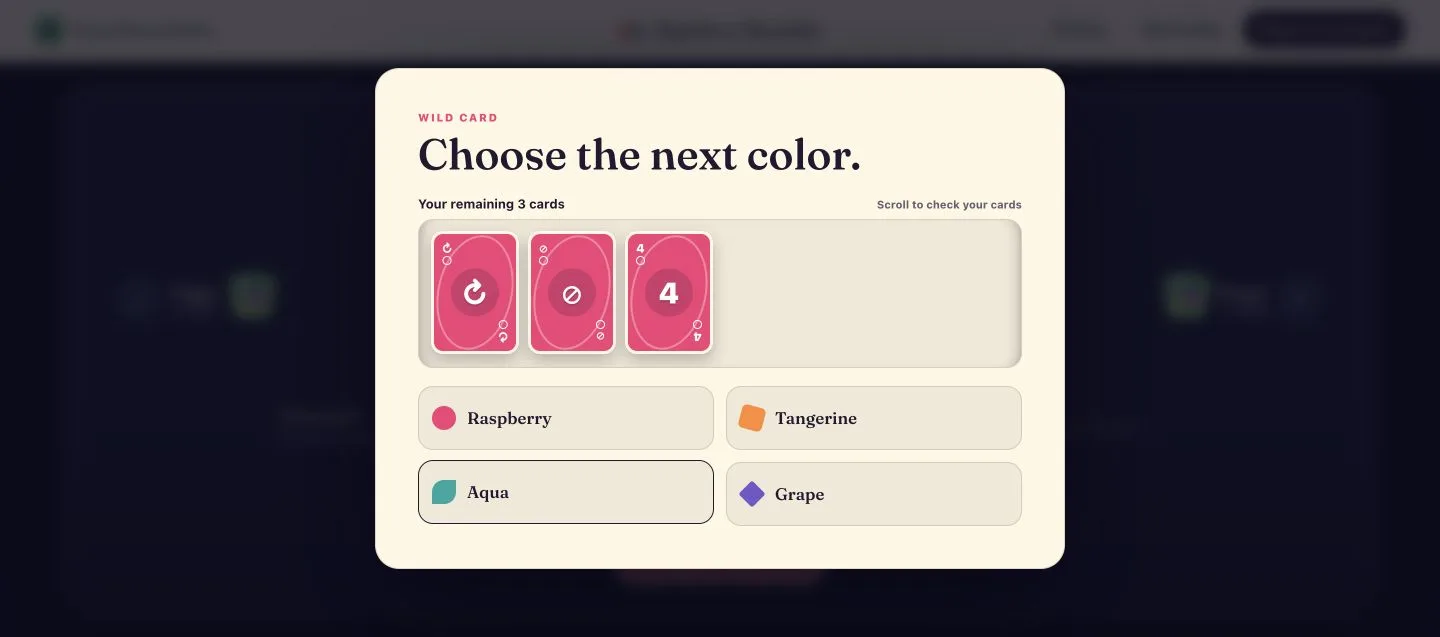
That difference changes how you prepare the endgame. If you want to preserve a Wild Draw Four, first remove cards in the current color when you can do so without giving an opponent an easy finish. A regular Wild is more flexible as a final card because it remains legal regardless of the current color. When choosing a Wild color, count the colored cards that will remain after the Wild leaves your hand. Select the largest group unless another player’s exposed pattern gives you a strong reason to block a particular color.
Plan the Rumble call before you tap
You must call “Rumble!” before playing down to one card. The interface stops a human player who tries to make that play without calling and focuses the call button. Calling also announces to the table that you are close to winning. Decide on your final two-card sequence before making the call. A flexible last card—especially a Wild or a color shared with your other card—is safer than a stranded number in a weak color.
The optional doubles rule makes this calculation less obvious. An exact pair means the same color, kind, and value, and you may play both together. If playing two cards would leave one, the Rumble call is still required before the pair is played. Both action effects count: two matching Draw Twos create four cards of penalty, while two Skips skip two active players. Look at the result of both actions before accepting the double.
Adjust your tactics for each custom rule
Wild +4 anytime removes the current-color restriction. Save the card for an opponent who is about to finish, or use it to force the color that dominates your hand. Because everyone has the same freedom, holding one too long can also be risky.
Stack draw cards lets a player answer Draw Two with Draw Two, or Wild Draw Four with Wild Draw Four. The total penalty grows until someone cannot or chooses not to continue. The two kinds do not mix. Keep a matching draw card when the player before you is likely to attack; spending your only defense for a small immediate gain can expose you to a much larger stack.
Draw to a match replaces a single draw with repeated draws until a playable card appears. Large hands become more common, so color concentration matters more. It also makes the 25-card knockout rule arrive faster when both options are active.
Play doubles rewards exact duplicates and accelerates the game. Treat a pair as a tactical resource rather than an automatic play. Two ordinary number cards are usually efficient. A paired Reverse or Skip can send the turn farther around the table than expected, while paired draw cards multiply the penalty.
25-card knockout changes the win condition when a hand reaches 25 cards: that player is eliminated, their cards return to the deck, and the last active player wins if only one remains. In this variant, forcing draws can remove a rival entirely. Also track your own distance from 25 before accepting a stack; drawing the penalty one turn earlier may be safer than allowing it to grow.
A reliable turn checklist
First, identify the opponent closest to emptying their hand. Second, list every legal card by color match and face match. Third, compare what each play leaves in your hand. Fourth, check whether an action changes who plays next. Finally, if the play leaves one card, call Rumble before playing. This short routine prevents most avoidable losses without slowing the game.
Rainbow Rumble includes private pass-and-play hands and an open-hands learning mode. Open hands are useful for teaching because everyone can discuss why a card is legal and what an action will do. Private hands make color control, memory, and timing more important. Whichever format you choose, confirm the active custom rules at setup so every player is making decisions under the same rule set.
Puzzle lineage: a modern member of the Eights family
Rainbow Rumble belongs to the broad shedding-game tradition in which players empty a hand by matching the top discard. Card-game historian John McLeod’s Crazy Eights rules and variants documents matching by rank or suit, a suit-changing Eight, a last-card call, and the many house rules found across the Eights family. Mattel’s official UNO product description likewise describes the familiar color-or-number matching structure.
Those sources explain the larger tradition, not Rainbow Rumble’s authorship. Rainbow Rumble is Green Bean Studio’s own browser implementation, with its raspberry, tangerine, aqua, and grape deck; Rumble call; computer players; open- or private-hand formats; and the optional rules documented above.
Play Rainbow Rumble in your browser, return to the strategy guide index, or read the website privacy policy.