I Spy Adventures guide · 6 min read
How to help a young player become a super spotter
I Spy Adventures is made for kids and is a child-directed game. This guide is written for young players and the parents, caregivers, or teachers playing beside them. The game uses friendly picture scenes, spoken clues, picture previews, and optional hints so pre-readers can take part. Both the game and this guide stay outside the site’s advertising boundary; this page is ad-free.
Start with a comfortable world and difficulty
Choose one of the twelve worlds, then choose Easy, Tricky, or Expert. Easy asks the player to find six objects, Tricky asks for eight, and Expert asks for ten. A first-time player can learn the tap-and-find rhythm on Easy before moving up. The harder settings increase the number of finds and change how much help the hint provides; they are not a race.
Press “Let’s play!” when the child is ready. Sparky gives one target at a time. The object preview offers a visual cue, while the spoken “I spy” prompt names the same target. The sound button repeats the clue when a player wants to hear it again.
Listen, look at the preview, then scan in sections
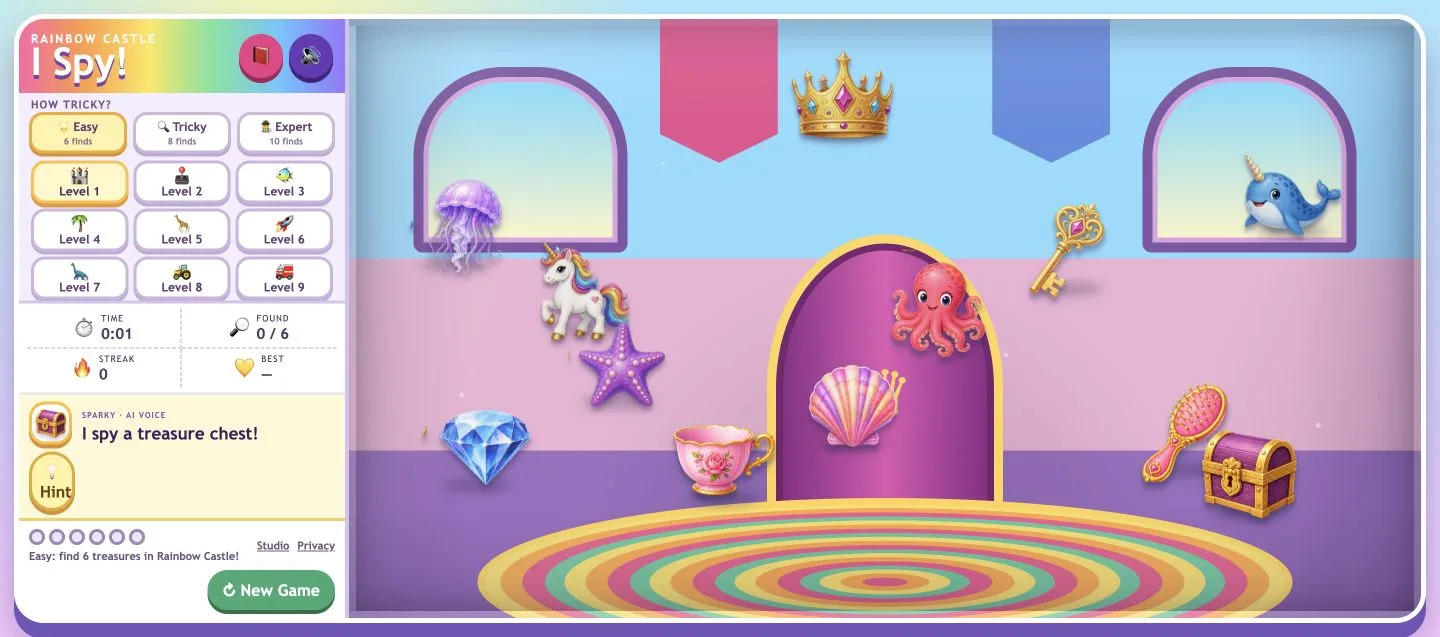
A simple search routine prevents random tapping. First look across the top of the scene, then the middle, then the bottom. On a wide screen, split each band into left and right halves. This teaches the child to finish one small area before moving to the next. It also makes it easier to remember which parts have already been checked.
Ask descriptive questions without pointing directly at the answer: “Is it tall or round?” “What color should we look for?” “Would it be up high or down near the ground?” This keeps the child in charge of the find while building visual vocabulary.
Use the hint as a learning tool
If the search stops being fun, press Hint. Depending on the selected difficulty, the game gives directional or scene-specific help and may highlight a broad zone. The hint narrows the search without requiring a child to guess. After using it, repeat the scan routine inside the suggested area.
A wrong tap does not end the round. Sparky gently repeats what the player is seeking, and play continues. The streak returns to zero, and the final star result reflects mistakes: no mistakes earns three stars, one or two mistakes earns two, and more mistakes earns one. Treat stars as a record of that round, not a grade. Replaying a favorite world is a useful way to practice careful scanning.
Celebrate progress with stars and stickers
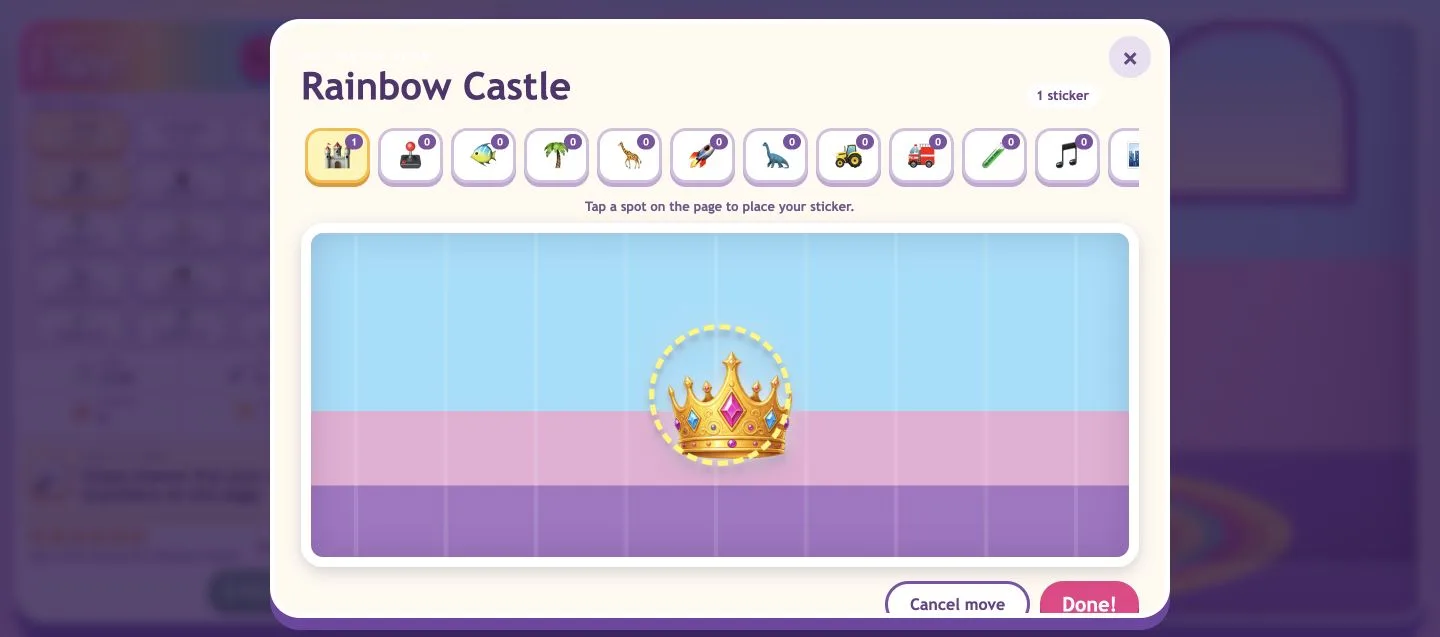
When every target is found, the completion card shows the elapsed time, hint count, and stars. The child can then choose one object from that adventure as a sticker. Each world has its own sticker-book page. Stickers can be dragged into place, or selected and placed with a second tap.
Progress, best times, stars, and sticker positions are stored locally in the browser. They are not tied to an account and can disappear if browser site data is cleared. A grown-up who wants to preserve a carefully arranged book should avoid clearing this site’s local storage.
A calm co-play routine
Let the child choose the world. Listen to the full clue together. Ask the child to describe the preview, then scan one section at a time. Offer the hint when attention starts to fade, not only after frustration. At the end, let the child choose and place the sticker. A short successful round is more useful than pushing through a setting that is too difficult.
Puzzle lineage: “I spy” and seek-and-find books
The spoken “I spy” prompt belongs to a long observational play tradition, and object-filled picture books turned that search into a page-by-page activity. Scholastic describes its photography-based I SPY series as beginning in 1992, created by author Jean Marzollo and photographer Walter Wick. On Walter Wick’s series archive, Wick explains how Marzollo’s vocabulary-building riddles joined his picture puzzles.
I Spy Adventures is Green Bean Studio’s separate browser game, not an edition of those books. It adapts the general listen-and-search pattern through original themed scenes, one-at-a-time spoken clues, three difficulty settings, stars, hints, and a local sticker book made for its young audience.
I Spy Adventures does not require an account and does not display advertising. For the site’s child-directed privacy boundary, read the website privacy policy. Then play I Spy Adventures or return to the guide index.