Draft Dash guide · 10 min read
How to run a fantasy draft-order draw your league can trust
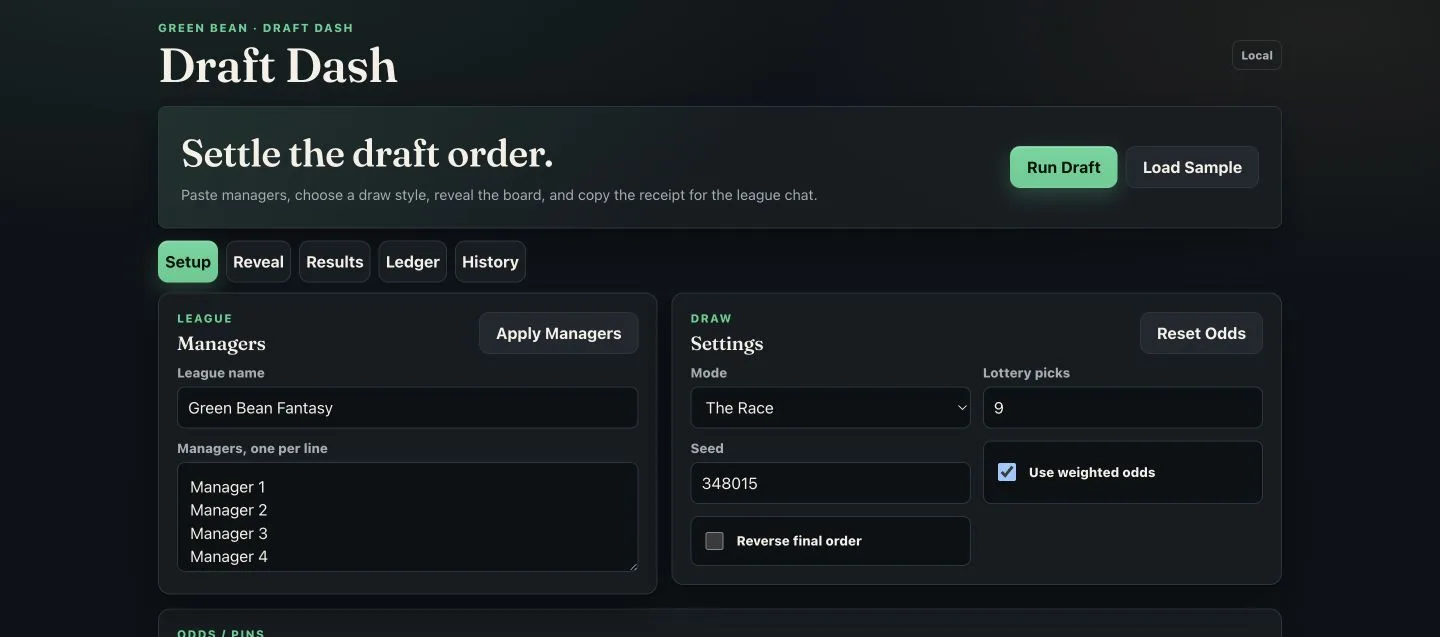
A fair draft-order draw starts before anyone presses the button. The league should agree on the participant list, the randomization method, any weighted odds, and any guaranteed picks in advance. Draft Dash supports two to sixteen managers, four reveal formats, seeded random results, optional weights, pick locks, a season ledger, and a detailed copyable receipt. Used carefully, those features make the process easier to explain. Used without agreement, the same controls can create an argument. This guide separates presentation choices from rules that change the result.
Choose the method before entering the seed
The Race and Card Flip use the same underlying ordered draw. The difference is presentation: Race animates managers down a field, while Card Flip reveals one pick at a time. If the participant list, seed, weights, pins, reverse setting, and ledger are identical, those two modes produce the same ranking.
Lottery assigns chances through four-number combinations drawn from 14 numbered balls. Draft Dash builds the 1,000 combinations used by the lottery, excluding 11-12-13-14. Each manager receives a share of those combinations based on their effective weight. Four balls are revealed for each lottery pick. A manager cannot win twice, and after the chosen number of lottery picks is filled, the remaining managers are ordered by a separate seeded weighted ranking.
Auction is not a random ranking with a decorative reveal. Each remaining manager submits a sealed bid for the current pick from their budget. The highest bid wins that pick and is deducted from the winner’s remaining budget. Ties are resolved from the seed and pick number. If everyone bids zero, the manager with the largest remaining budget wins; a tie at that budget is seeded. Auction therefore needs active league decisions during the run and is best when managers can participate live.
Use equal odds unless the league approved a reason not to
With weighting off, each unpinned manager has the same chance at the first available pick. With weighting on, a manager’s weight controls their relative chance. A 2.0 weight has twice the first-pick share of a 1.0 weight when no pins intervene. Draft Dash accepts weights from 0.2 to 5.0. The percentages displayed in setup are relative shares among managers eligible for pick one; they are not a promise about every position on the completed board.
The weighted ranking uses a seeded random key for each manager and sorts those keys. That produces an ordering without repeatedly drawing and replacing names. The practical rule is simple: publish weights before the draw. If last place earns better odds, decide the exact scale in the league constitution or a dated league message. Do not adjust weights after seeing a sample result.
The Reset Odds control returns every manager to weight 1, turns weighting off, and removes odds boosts and penalties from the ledger. Use it when the league decides on a fully equal draw. Check the setup percentages afterward; equal eligible managers should show equal first-pick chances, apart from rounding.
Understand pins and the League Ledger
A pin locks one manager to a specific pick. Pinned managers are removed from the random flow, and the other managers fill the open positions in their generated order. A manager pinned to pick one has a displayed first-pick chance of 100 percent. Pins are appropriate for rules already earned—for example, a consolation winner guaranteed the third selection—but they should never be hidden as commissioner adjustments.
The League Ledger records four kinds of entries: odds boosts, odds penalties, pick locks, and notes. Odds entries add to or subtract from a manager’s base weight, with the final effective weight limited to the supported 0.2-to-5 range. Pick-lock entries create pins. Notes document a consequence without changing the draw. A useful ledger entry names the rule, not merely the outcome: “Last-place bonus under 2026 league rules” is clearer than “Commissioner adjustment.”
Draft Dash includes all ledger entries and commissioner pins in the full recap. That transparency matters more than the animation. Before the draw, read the ledger aloud or paste it into the league chat and give managers time to object.
Treat the seed as part of the rules
The seed is a number that initializes Draft Dash’s repeatable random generator. Keeping the same inputs and seed makes the random process reproducible in the same version of the tool. Changing the seed changes the result. Agree on how to select it before opening the final board. Common approaches include using a number announced by a non-participant, a date defined in advance, or the default random seed shown when the page loads.
A seed does not prove that the commissioner never previewed other seeds. Process solves that problem. Share the participant list and settings first, generate the seed in view of the league, and run the draft once. Loading samples is useful for learning the interface, but reset to the real managers and agreed settings before the official run.
Use reverse order only when it matches the format
The Reverse Order option flips the generated ranking before pins are applied. It does not create a snake draft. If your fantasy platform already turns a first-round order into a snake sequence, leave Draft Dash focused on the initial manager order and configure snake behavior on that platform. Turning on reverse merely makes the last generated manager first, the next-to-last second, and so on.
Finish with a receipt, not a screenshot alone
After the board is complete, Draft Dash creates a recap with the league name, mode, result, proof code, execution time, seed, weighting and reverse settings, lottery-pick count, pins, ledger, and manager settings. The proof code is a compact checksum derived from the mode, seed, and final order. It is useful for spotting whether a shared board differs from the recorded result, but it is not a cryptographic signature and does not independently validate the fairness of the inputs.
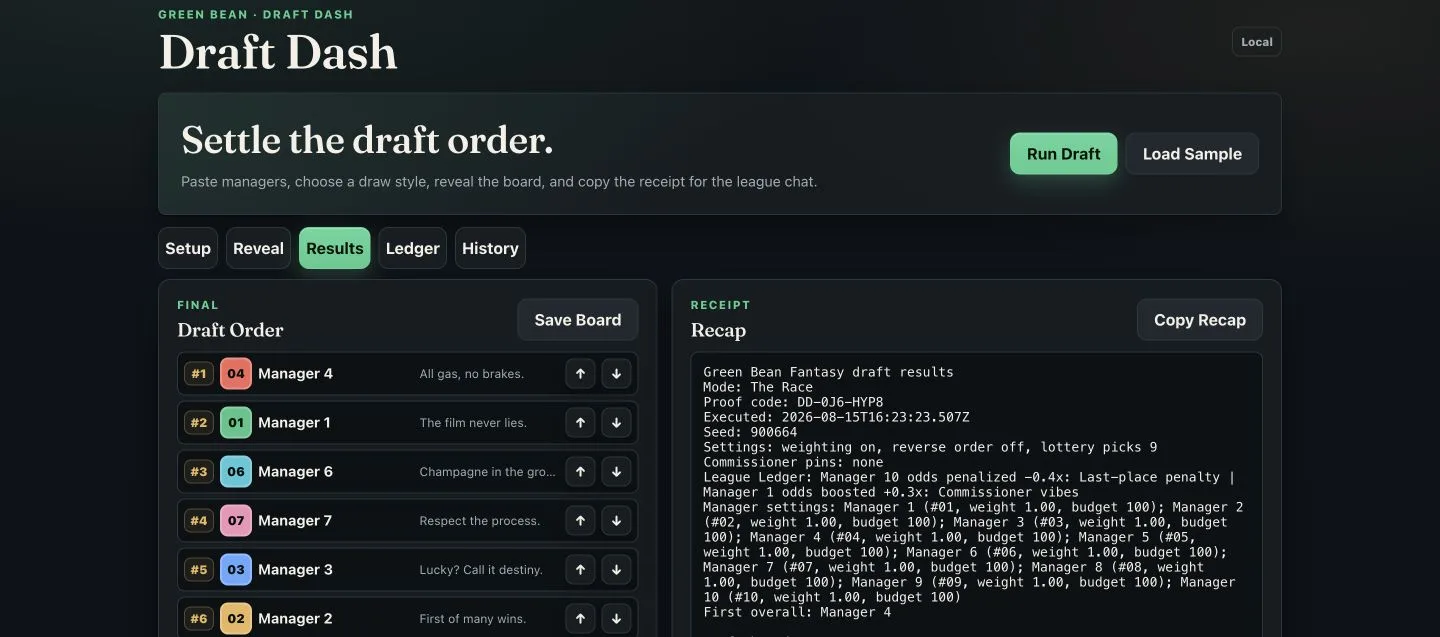
Copy the full recap into the league’s permanent channel. If the commissioner manually moves a pick on the results screen, the proof code changes. Document why the edit was made. Draft Dash can save up to 25 completed boards in the browser’s local storage, but that history stays on that browser and can disappear if site data is cleared. The league chat receipt should be the durable record.
A defensible five-step draft process
First, freeze the manager list and remove duplicates. Second, record the selected mode, weights, lottery-pick count, reverse setting, pins, and ledger consequences. Third, let the league inspect those inputs. Fourth, choose or reveal the seed and run the draw once. Fifth, copy the full recap immediately and save it outside the browser. For an auction, add one more rule: specify who may see bids, how long each bid window lasts, and what happens if a manager is absent.
Puzzle lineage: drawing order before the draft
Randomly assigning an order is an established part of fantasy-league setup rather than an invention of Draft Dash. For one current example, the NFL Fantasy help guide says its standard draft order is randomly determined, while custom-league commissioners can set it. Leagues also use informal lots, cards, names in a hat, lotteries, contests, or auction rules; there is no single documented origin for all of those traditions.
Draft Dash is Green Bean Studio’s implementation of this league-management step. Its seeded Race, Card Flip, Lottery, and Auction modes, weighting, pins, ledger, and recap are product-specific tools. The historical practice explains why leagues determine an order; it does not certify a particular Draft Dash setup as fair. That still depends on disclosed inputs and league agreement.
No interface can settle a policy the league never agreed on. Draft Dash is most useful when the social rules are explicit and the tool handles the mechanical work. Open Draft Dash, browse the other strategy guides, or review the website privacy policy for details about local browser data.